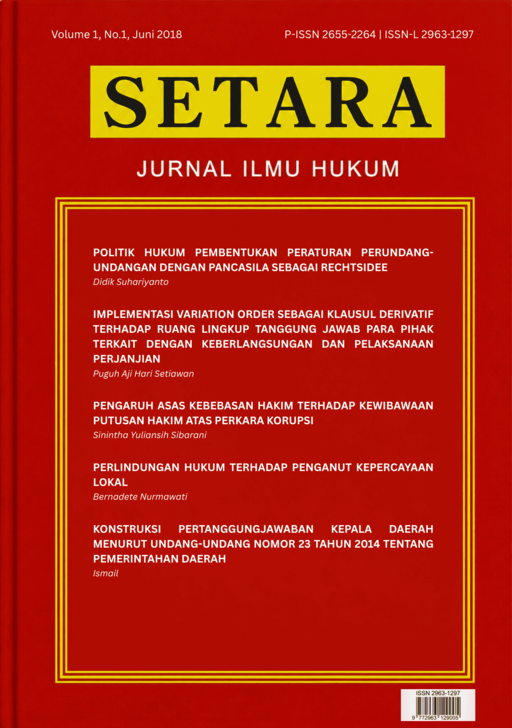
Politik Hukum Pembentukan Peraturan Perundang-Undangan dengan Pancasila sebagai Rechtsidee
Penulis

DOI
10.59017/setara.v1i1.220
Kata Kunci:
Legal Politics, Paradigm, Pancasila, Rechtsidee, LegislationAbstrak
The philosophical paradigm values in the formation of laws and regulations as legal norms contain the awareness, appreciation of values, attitudes, ideas, and concepts of political authorities. Pancasila, as the soul of the nation and as the legal ideal (rechtsidee), is a source of law in the formation of legislation. Theoretically, the formation of legislation is based on the legal norms of society, while juridically, constitutional amendments affect the formation of legislation. Paradigm changes influence the legal politics of forming laws and regulations and affect their implementation in society. The authority to form laws and regulations, which was previously held by the President, has shifted to the House of Representatives. Legal politics cannot be separated from Pancasila as rechtsidee, which serves as the basis for advancing the nation and state in accordance with the nation's culture.
Referensi
Amin, M. (2018). Tugas dan wewenang lembaga-lembaga negara Republik Indonesia menurut Undang-Undang Dasar Tahun 1945 setelah amandemen. Jurnal Fundamental, 7(1), 94-105.
Attamimi, A. H. S. (1989). Fungsi ilmu perundang-undangan dalam pembentukan hukum nasional.
Bentham, J. (2016). Teori perundang-undangan: The theory of legislation. Nuansa Cendekia.
Budiyono. (2000). Dasar-dasar hukum tata negara. Erlangga.
Indrati, M. F. (1996). Ilmu perundang-undangan: Dasar-dasar dan pembentukannya. Universitas Indonesia.
Joeniarto. (1996). Sejarah ketatanegaraan Republik Indonesia. Bumi Aksara.
Konradus, D. (2016). Politik hukum berdasarkan konstitusi. Jurnal Masalah-Masalah Hukum, 45(3), 205-214.
Kurniawaty, Y. (2016). Penggunaan diskresi dalam pembentukan produk hukum (The use of discretion in the formation of a legal product). Jurnal Legislasi Indonesia, 13(1), 53-64.
Lubis, M. S. (1985). Undang-Undang Dasar sebagai konsep dasar sistem pengelolaan kehidupan nasional. Universitas Sumatera Utara.
MD, M. M. (2007). Perdebatan hukum tata negara. Pustaka LP3ES Indonesia.
Notonagoro. (1957). Pancasila dasar filsafat negara Republik Indonesia. Universitas Gadjah Mada.
Setyowati, P. J. (2016). Fungsi filsafat, agama, ideologi dan hukum dalam perkembangan politik di Indonesia. Yuridika: Jurnal Ilmu Hukum, 31(1), 82-93.
Soekanto, S. (1989). Kegunaan sosiologi hukum bagi kalangan hukum. Citra Aditya Bakti.
Subiharta. (2015). Moralitas hukum dalam hukum praksis sebagai suatu keutamaan (Legal morality in practical law as a virtue). Jurnal Hukum dan Peradilan, 4(3), 385-398.
Suseno, F. M. (1987). Etika politik: Prinsip-prinsip moral dasar kenegaraan modern. Gramedia.
Tardjono, H. (2016). Reorientasi politik hukum pembentukan undang-undang di Indonesia. Jurnal Renaissance, 1(2), 63-72.
Thaha, I. (2005). Demokrasi religius. Teraju.
(1945). Undang-Undang Dasar Negara Republik Indonesia Tahun 1945.
(2003). Undang-Undang Nomor 23 Tahun 2003 tentang Pemilihan Umum Presiden dan Wakil Presiden.
(2004). Undang-Undang Nomor 10 Tahun 2004 tentang Pembentukan Peraturan Perundang-Undangan.
(2008). Undang-Undang Nomor 42 Tahun 2008 tentang Pemilihan Umum Presiden dan Wakil Presiden.
(2011). Undang-Undang Nomor 12 Tahun 2011 tentang Pembentukan Peraturan Perundang-Undangan.
(2017). Undang-Undang Nomor 7 Tahun 2017 tentang Pemilihan Umum.
Unduhan


Diterbitkan
Terbitan
Bagian
Lisensi
Hak Cipta (c) 2018 Didik Suhariyanto

Artikel ini berlisensi Creative Commons Attribution 4.0 International License.