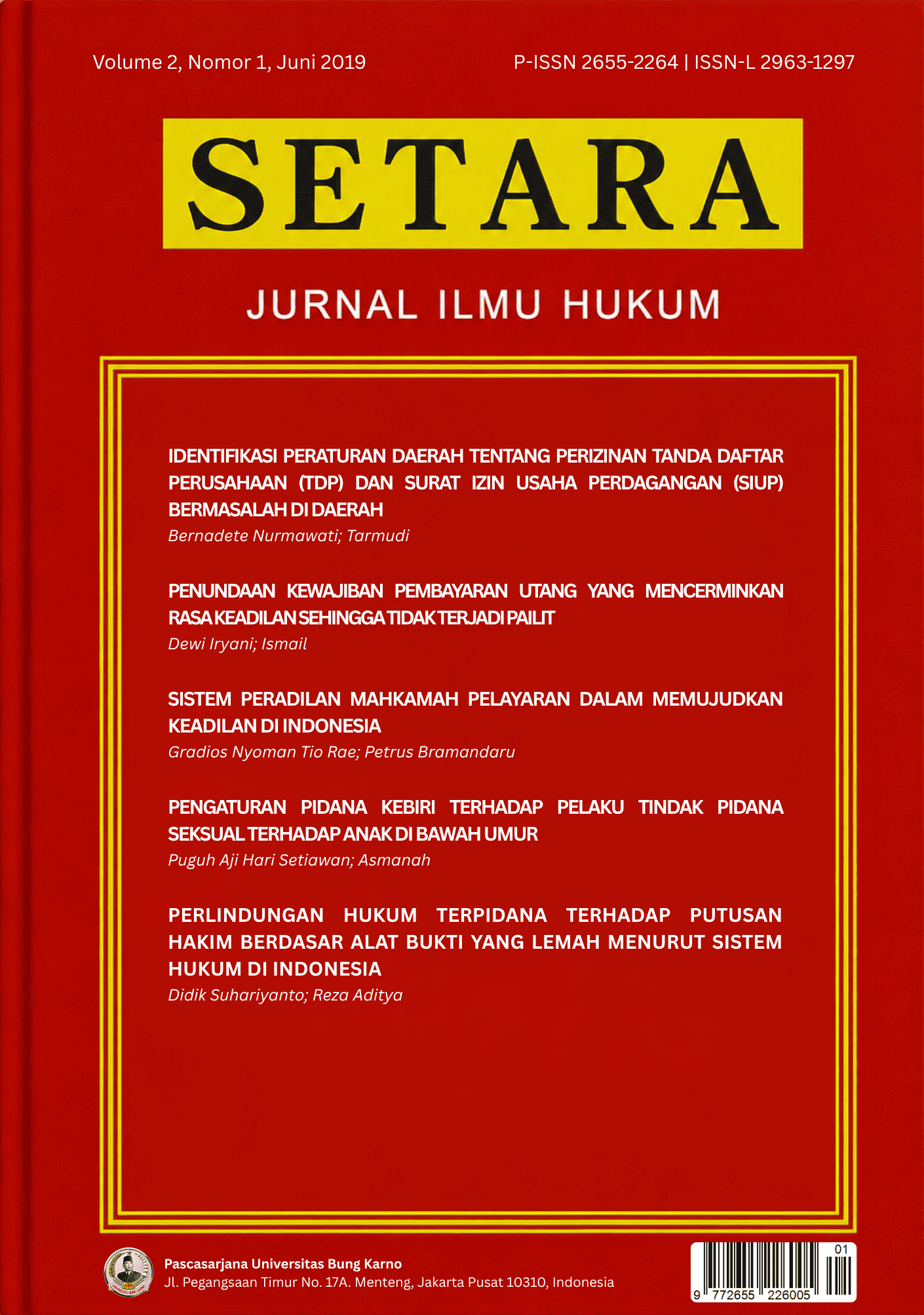
Pengaturan Pidana Kebiri terhadap Pelaku Tindak Pidana Seksual terhadap Anak di Bawah Umur
Penulis

DOI
10.59017/setara.v2i1.210
Kata Kunci:
Chemical Castration, Sexual Crime, Child Protection, Penal Policy, DeterrenceAbstrak
This article discusses the regulation of chemical castration as an additional punishment for perpetrators of sexual crimes against minors. The enactment of Law Number 17 of 2016, which introduced stronger sanctions including chemical castration and electronic monitoring, was intended as a response to the increasing severity of sexual violence against children. Using normative juridical research, the article examines the relationship between the Child Protection Law, Government Regulation in Lieu of Law Number 1 of 2016, and Law Number 17 of 2016, while also addressing debates about human rights, deterrence, and the limits of penal policy. The study finds that although the state views sexual violence against children as an extraordinary crime requiring stronger punishment, chemical castration remains highly controversial because its effectiveness is uncertain and it does not by itself resolve the roots of sexual violence. The article therefore concludes that stricter punishment must be accompanied by broader preventive and rehabilitative measures in order to protect children more effectively.
Referensi
Asmawi, M. (2005). Lika-liku seks menyimpang: Bagaimana solusinya. Darussalam Offset.
Gosita, A. (1987). Relevansi viktimologi dengan pelayanan terhadap para korban perkosaan. Akademika Pressindo.
Gosita, A. (1989). Masalah perlindungan anak. Akademika Pressindo.
Lamintang, P. A. F. (1990). Delik-delik khusus tindak pidana-tindak pidana melanggar norma-norma kesusilaan dan norma-norma kepatutan. Mandar Maju.
Lamintang, P. A. F. (2000). Dasar-dasar hukum pidana di Indonesia. Sinar Baru.
Sawitri, S. S. (2005). Bunga rampai kasus gangguan psikoseksual. Refika Aditama.
Sianturi, S. R. (1986). Asas-asas hukum pidana di Indonesia dan penerapannya. Alumni Ahaem-Petehaem.
Kitab Undang-Undang Hukum Pidana.
Peraturan Pemerintah Pengganti Undang-Undang Nomor 1 Tahun 2016 tentang Perubahan Kedua atas Undang-Undang Nomor 23 Tahun 2002 tentang Perlindungan Anak.
Undang-Undang Nomor 23 Tahun 2002 tentang Perlindungan Anak.
Undang-Undang Nomor 35 Tahun 2014 tentang Perubahan atas Undang-Undang Nomor 23 Tahun 2002 tentang Perlindungan Anak.
Undang-Undang Nomor 17 Tahun 2016 tentang Penetapan Peraturan Pemerintah Pengganti Undang-Undang Nomor 1 Tahun 2016 tentang Perubahan Kedua atas Undang-Undang Nomor 23 Tahun 2002 tentang Perlindungan Anak Menjadi Undang-Undang.
Rachmawati, E. S. (2005). Sisi kelam pariwisata di Pulau Dewata. Kompas.