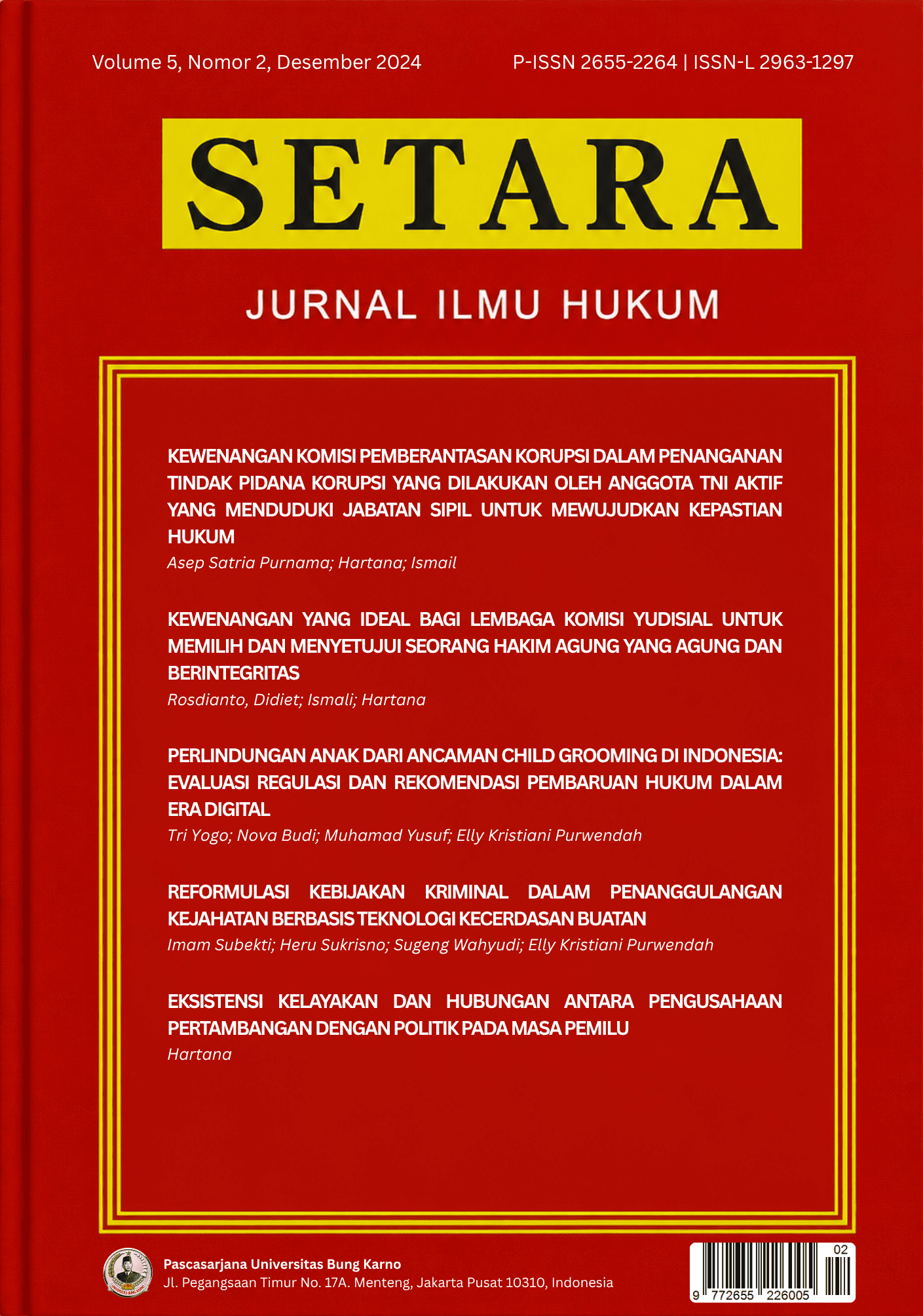
Kewenangan yang Ideal bagi Lembaga Komisi Yudisial untuk Memilih dan Menyetujui Seorang Hakim Agung yang Agung dan Berintegritas
Authors


DOI
10.59017/setara.v5i2.557
Keywords:
Judicial Commission, Supreme Court Justice, Fit and Proper Test, Judicial Independence, Separation of PowersAbstract
The selection of Supreme Court Justices often attracts public attention because it concerns the integrity and independence of the judiciary. This study examines the regulation of Supreme Court Justice nominations in the Indonesian legal system and formulates the ideal authority of the Judicial Commission in selecting and approving candidates with integrity. This research uses a normative juridical method with statutory, conceptual, and historical approaches. The legal materials consist of primary and secondary legal materials. The study finds that potential conflicts of interest arising from the involvement of the House of Representatives in fit and proper tests are not fully consistent with the principle of separation of powers under the 1945 Constitution. An ideal selection process should focus on integrity, professionalism, and transparency without political intervention. The establishment of an independent and credible National Selection Committee can support a more transparent and accountable selection process.
References
Asshiddiqie, J. (2006). Perkembangan dan konsolidasi lembaga negara pasca reformasi. Sekretariat Jenderal dan Kepaniteraan Mahkamah Konstitusi.
Asshiddiqie, J. (2010). Konstitusi dan konstitusionalisme Indonesia. Sinar Grafika.
Fajrul Falaakh, M. (2009). Komisi Yudisial dan reformasi peradilan. Jurnal Hukum Ius Quia Iustum, 16(2), 187--205.
Lev, D. S. (1990). Hukum dan politik di Indonesia: Kesinambungan dan perubahan. LP3ES.
Manan, B. (2005). Sistem peradilan berwibawa: Suatu pencarian. FH UII Press.
Marzuki, P. M. (2017). Penelitian hukum. Kencana.
Soekanto, S., & Mamudji, S. (2015). Penelitian hukum normatif: Suatu tinjauan singkat. RajaGrafindo Persada.
Undang-Undang Dasar Negara Republik Indonesia Tahun 1945.
Undang-Undang Nomor 14 Tahun 1985 tentang Mahkamah Agung.
Undang-Undang Nomor 5 Tahun 2004 tentang Perubahan atas Undang-Undang Nomor 14 Tahun 1985 tentang Mahkamah Agung.
Undang-Undang Nomor 3 Tahun 2009 tentang Perubahan Kedua atas Undang-Undang Nomor 14 Tahun 1985 tentang Mahkamah Agung.
Undang-Undang Nomor 22 Tahun 2004 tentang Komisi Yudisial.
Undang-Undang Nomor 48 Tahun 2009 tentang Kekuasaan Kehakiman.
Undang-Undang Nomor 18 Tahun 2011 tentang Perubahan atas Undang-Undang Nomor 22 Tahun 2004 tentang Komisi Yudisial.
Putusan Mahkamah Konstitusi Nomor 005/PUU-IV/2006.