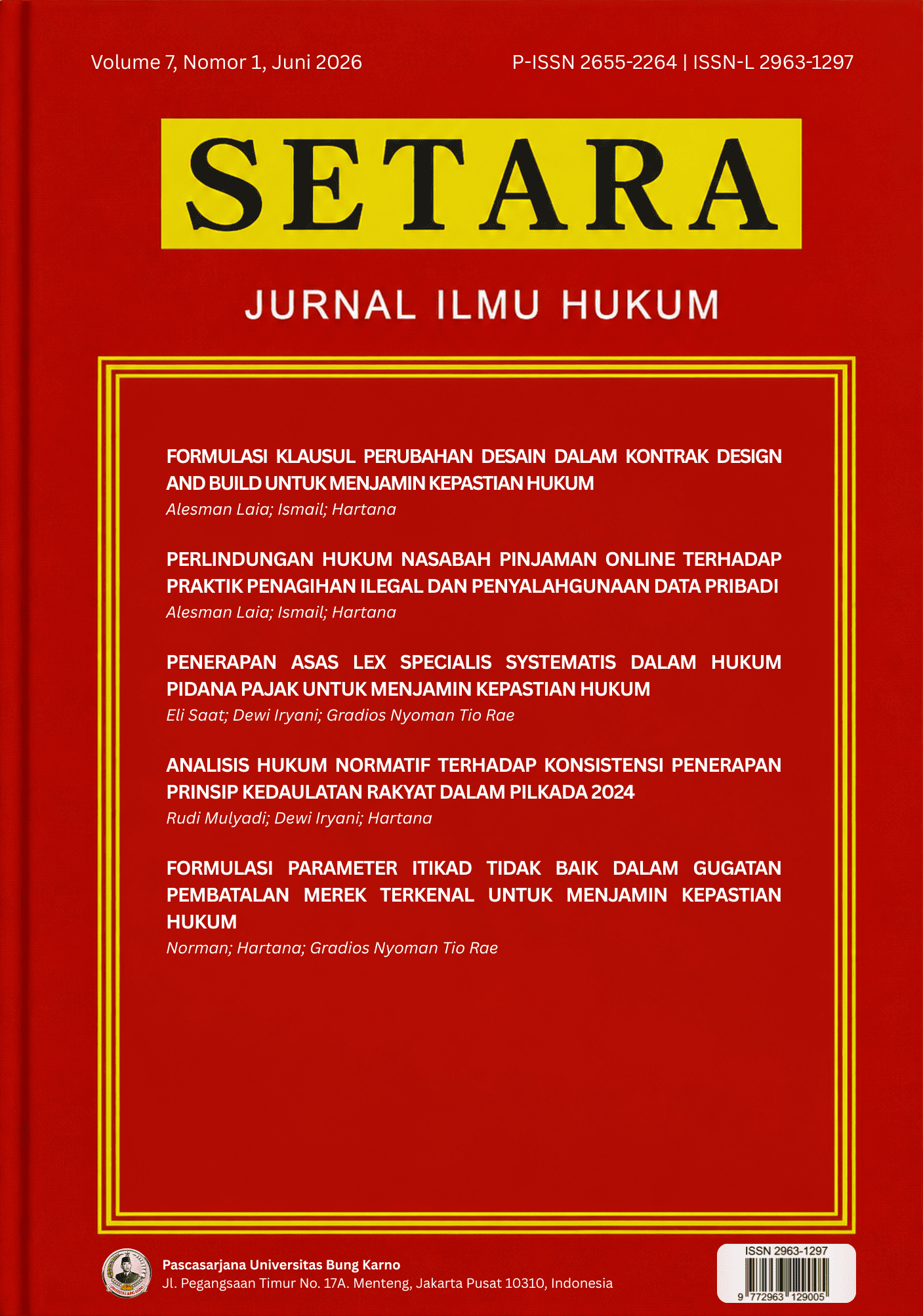
Formulasi Parameter Itikad Tidak Baik dalam Gugatan Pembatalan Merek Terkenal untuk Menjamin Kepastian Hukum
Authors


DOI
10.59017/setara.v7i1.614
Keywords:
Well-Known Trademark, Bad Faith, Cancellation Action, Legal Certainty, Trademark ProtectionAbstract
This article examines how bad faith should be formulated as an operational legal parameter in cancellation actions involving well-known trademarks. The issue is important because Indonesian trademark law has recognized special protection for well-known marks and has opened an exception to the limitation period for cancellation claims filed against registrations made in bad faith. However, in practice, claims are often trapped in formal debates over the first to file principle, while the proof of bad faith remains fragmented and highly dependent on judicial interpretation. This study uses normative legal research with statutory, conceptual, and case approaches. The analysis is grounded in the official Indonesian trademark regime, international instruments on well-known marks, and judicial practice that reveals the gap between the promise of protection and its implementation. The findings show that the main weakness does not lie in the absence of norms, but in the absence of a structured test linking the notoriety of a mark, the registrant's prior knowledge, the pattern of registration, the commercial objective, and post-registration conduct. Therefore, this article formulates a five-part operational parameter of bad faith and recommends a contextual burden-shifting model so that cancellation actions involving well-known trademarks can be assessed more consistently, fairly, and predictably.
References
Gautama, S. (1993). Hukum Merek Indonesia. Citra Aditya Bakti.
Saidin, O. K. (2021). Aspek Hukum Hak Kekayaan Intelektual. Rajawali Pers.
Miru, A. (2015). Hukum Merek: Cara Mudah Mempelajari Undang-Undang Merek. RajaGrafindo Persada.
Gunawati, A. Z. U. P. (2015). Perlindungan Merek Terkenal Barang dan Jasa Tidak Sejenis terhadap Persaingan Usaha Tidak Sehat. PT Alumni.
Margono, S. (2010). Hukum Merek di Indonesia. Kencana.
Hadjon, P. M. (1987). Perlindungan Hukum bagi Rakyat di Indonesia. Bina Ilmu.
Ibrahim, J. (2007). Teori dan Metode Penelitian Hukum Normatif. Bayumedia Publishing.
World Intellectual Property Organization. (1883). Paris Convention for the Protection of Industrial Property. https://www.wipo.int/treaties/en/ip/paris/
World Intellectual Property Organization. (1999). Joint Recommendation Concerning Provisions on the Protection of Well-Known Marks. https://www.wipo.int/edocs/pubdocs/en/marks/833/pub833.pdf
World Trade Organization. (1994). Agreement on Trade-Related Aspects of Intellectual Property Rights. https://www.wto.org/english/docs_e/legal_e/27-trips.pdf
(2016). Undang-Undang Nomor 20 Tahun 2016 tentang Merek dan Indikasi Geografis.
(2016). Peraturan Menteri Hukum dan Hak Asasi Manusia Nomor 67 Tahun 2016 tentang Pendaftaran Merek.
(2021). Peraturan Menteri Hukum dan Hak Asasi Manusia Nomor 12 Tahun 2021 tentang Perubahan atas Peraturan Menteri Hukum dan Hak Asasi Manusia Nomor 67 Tahun 2016 tentang Pendaftaran Merek.
(2015). Putusan Pengadilan Niaga pada Pengadilan Negeri Jakarta Pusat Nomor 15/Pdt.Sus-Merek/2015/PN.Niaga.Jkt.Pst..
(2015). Putusan Mahkamah Agung Republik Indonesia Nomor 557 K/Pdt.Sus-HKI/2015.
Downloads
Published
Issue
Section
License
Copyright (c) 2026 Nabil, Ismail, Hartana (Author)

This work is licensed under a Creative Commons Attribution 4.0 International License.